
A personal birth story
This story talks about experiences in Special Care Nursery and premature babies, in which you may find hard to read. If you find this story brings up some difficult emotions for you please contact PANDA for further support.
Birthdays are a celebration in our household, all our birthdays full within a 6 week period so I like to call it ‘Birthday Season!”
However, every year around this time I tend to go in reflection mode, as I think about the birth of my son.
It is always a challenge to accept the things that we cannot change, and I do have a beautiful happy 3 year old boy. I am blessed.
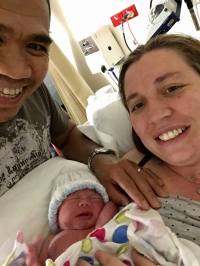
Leo is known as a late-preterm baby. He was born at 34.6 weeks at a very healthy weight for a baby born that early. I spent a week in hospital when my waters broke at 33 weeks and then went into labour naturally a week later.
My pregnancy and labour were not straight forward, as it was for my daughter two years earlier.
My daughter was born on her due date, laboured at home with no medical intervention and with a super quick ambulance trip to the hospital was delivered safely with 14 minutes to spare.
We expected a straightforward, quick labour with our second. Unfortunately it didn’t happen.
At 8 weeks, before I had seen my little baby’s heartbeat, I had a bleed and thought we had miscarried. We manage to make an appointment with our obstetrician a day later, and was able to hear our baby’s strong heartbeat. Everything was fine.
During the labour with Leo, I had multiple medical intervention including two internal examinations. I was told I needed to lie down on my back during contractions, had the midwife touching my pelvis constantly and a drip for medication. I was even questioned if “I really needed to push” when I started pushing!
15 minutes later Leo arrived into the world with just the midwife in the room.
I had approx. 2 hours of skin-to-skin contact, and an opportunity for my little boy to latch and fed. In which he did very well.
However, he was then taken away to special care nursery, where a nasal-gastric tube was inserted, formula was provided and I was told to pump every 3 hours.
I was determined to breast feed, and so the pumping of 3-4 hourly begun.
I was separated from Leo from birth. He was in special care nursery I was upstairs on a different floor.
I was discharged after four nights at the hospital, and Leo was discharged five days later.
I will never forget the day I was discharged from hospital and I had to leave my son behind. The tears, the fear, the frustration and the anger. Yes, there was a moment where I collapsed in my husbands arms as I crossed the road. I could barely stand.
Our time in Special Care, was a challenging time, with a lot of errors around communication including visits from the paediatrician without my knowledge, running 5 minutes late and missing out on feeds after I was discharged and being told there was no need to visit during the night while we both were in hospital.
Having a child in special care presents many challenges. Post-natal depression is higher in parents with a baby taken to special care whether it’s for medical reasons or due to premature.
I met some amazing mums (and dads) in special care, some who had spent months in hospital in NICU and then transferred into SCN.
It certainly was a very different experience to my first born.
A lot of things happened during this period that I questioned. My experience of working for many years in Early Childhood Intervention Services, has taught me about the importance of recognising the role of the parent/patient as the priority in the care of their baby. Your rights as a parent both during labour and the after care whilst in special care should be highly regarded. You have the right to be given informed choices about the rights of your baby and to be contacted when a paediatrician is visiting.
Overall if the baby is thriving, then shouldn’t they be encourage to thrive with their mother?
Remember you are the most important person to your little human being.
Please note: These ideas are based on a straight forward labour, if you are high risk, you or your baby is at risk, it’s important to follow medical advice.
So if you are due to have a baby, I want you to remember the following:
- It’s ok to refuse an internal examination to see how far you’ve dilated. There is an alternative measure to check, called “The Purple Line”. This line runs from the anus upwards or otherwise known as her “butt crack” and you can find out more here.
- Don’t be afraid to refuse, as long as it’s safe to do so. You can labour in whatever position you are comfortable in. If you are not happy, speak up and if possible ask for someone different.
- If your child ends up in special care, you have the right to visit when you can. If that means you want to visit every 3-4 hours to pump/express in front of your baby then do especially if you are staying in hospital for a couple of nights.
- Do speak up, if you want to be there during all visits from the paediatrician. If you have had to go home but your baby is still in Special Care, make sure you ring to let them know you are on your way or running late and to wait until you are there to feed the baby. (Unless you are running super late)
- If something doesn’t feel right, or you are not happy speak up. You are by far the most important person to your new little human being, and although your baby may need special care, you have every right to be informed and visit if you are medically able to do so.
- And remember, women have been giving birth for many many years, it’s important to listen to your body, if something doesn’t feel right speak up. If you know what you need when giving birth then follow those cues. Unless there is a medical reason, or your baby or yourself is in distress, then remember you have many rights as a parent.
- And lastly, be clear with your birthing partner as sometimes you are unable to communicate your needs, your birthing partner will need to speak on your behalf.
How was your birthing experience? Did you have a baby in special care?
What was your experience like?
If this story, brings up challenges and you would like to talk to someone please contact your local Maternal & Child Health Nurse, PANDA (Perinatal Anxiety & Depression Australia), COPE (Centre of Perinatal Excellence) or Lifeline.
 The Early Parenting Village, Cheltenham Victoria - all rights reserved